
Former Hospital Site (176 Wellington Street)
Project Overview
The Town of Niagara-on-the-Lake is exploring future opportunities for the Former Hospital Site at 176 Wellington Street. This work includes evaluating options for a civic building that could support community space, visitor amenities, and parking, while respecting the historic character of Old Town. This page will be updated as the project progresses.
Current State
The project is currently in the preliminary feasibility and concept development phase. Initial analysis has confirmed that community space, visitor amenities, and parking could be accommodated on the site. This concept remains high-level and subject to further refinement. Council has directed staff to proceed with more detailed design work, technical studies, and financial modelling to better assess feasibility before any final decisions are made.
Engagement Overview
The Town of Niagara-on-the-Lake partnered with NPG Planning Solutions Inc. to lead a community engagement process to consider future uses for the Former Hospital Site at 176 Wellington Street in Old Town.
Throughout 2025, several engagement opportunities were held, including:
- A survey
- Interactive community mapping and community boards
- Targeted small-group workshops
- Community walks and conversations
- In-person Public Information Centres (PICs)
The outcome of the engagement opportunities can be found under the Public Engagement Documents section of this project page.
Guiding Principles
The concept is grounded in key guiding principles identified through the public engagement process by NPG, including:
- Recognizing the frontage along Queen’s Parade as a primary entrance into the historic Old Town through enhanced streetscape improvements and high-quality built form that fosters a strong sense of arrival
- Enhancing wayfinding on Queen’s Parade and Wellington Street to create a cohesive and navigable streetscape experience
- Promoting safety, connectivity, and accessibility for people of all ages and abilities through improved sidewalks, pathways, and connections to existing trails
- Protecting and sustaining existing green space and mature trees to preserve the character of Wellington Street and provide a transition between land uses
- Fostering a pedestrian-oriented environment through streetscape features such as signage, lighting, street furniture, planting, public art, and shade trees
- Supporting a compatible site design and built form that respects the surrounding historic context
Strategic Plan Alignment
This engagement initiative aligns with Council’s 2022–2027 Strategic Plan under the Enrich Community Assets, Environment & Infrastructure pillar. The goal of the engagement is to gather community feedback on how to transform the site into a space that reflects the community's values and future needs.
About the Site
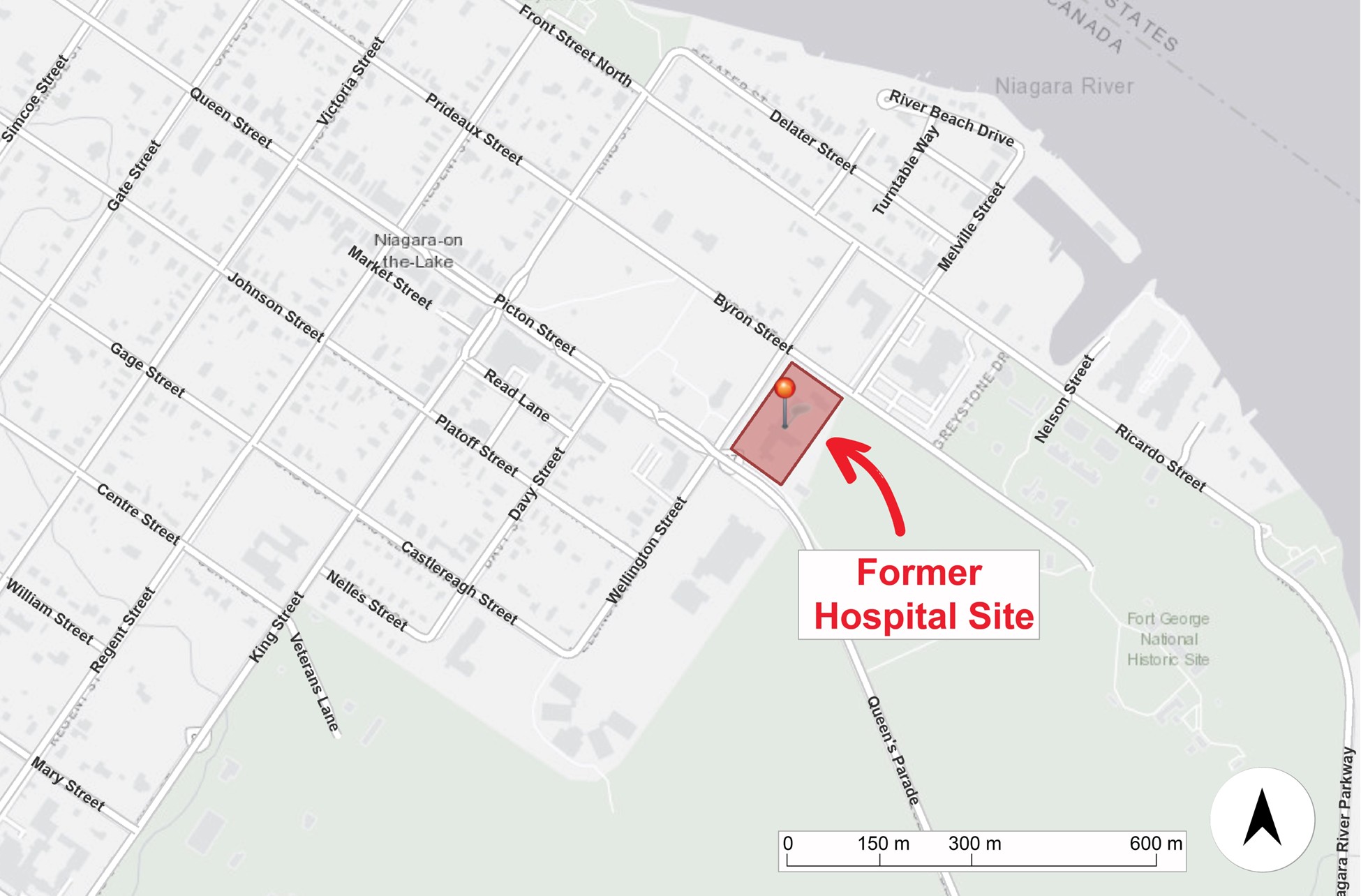
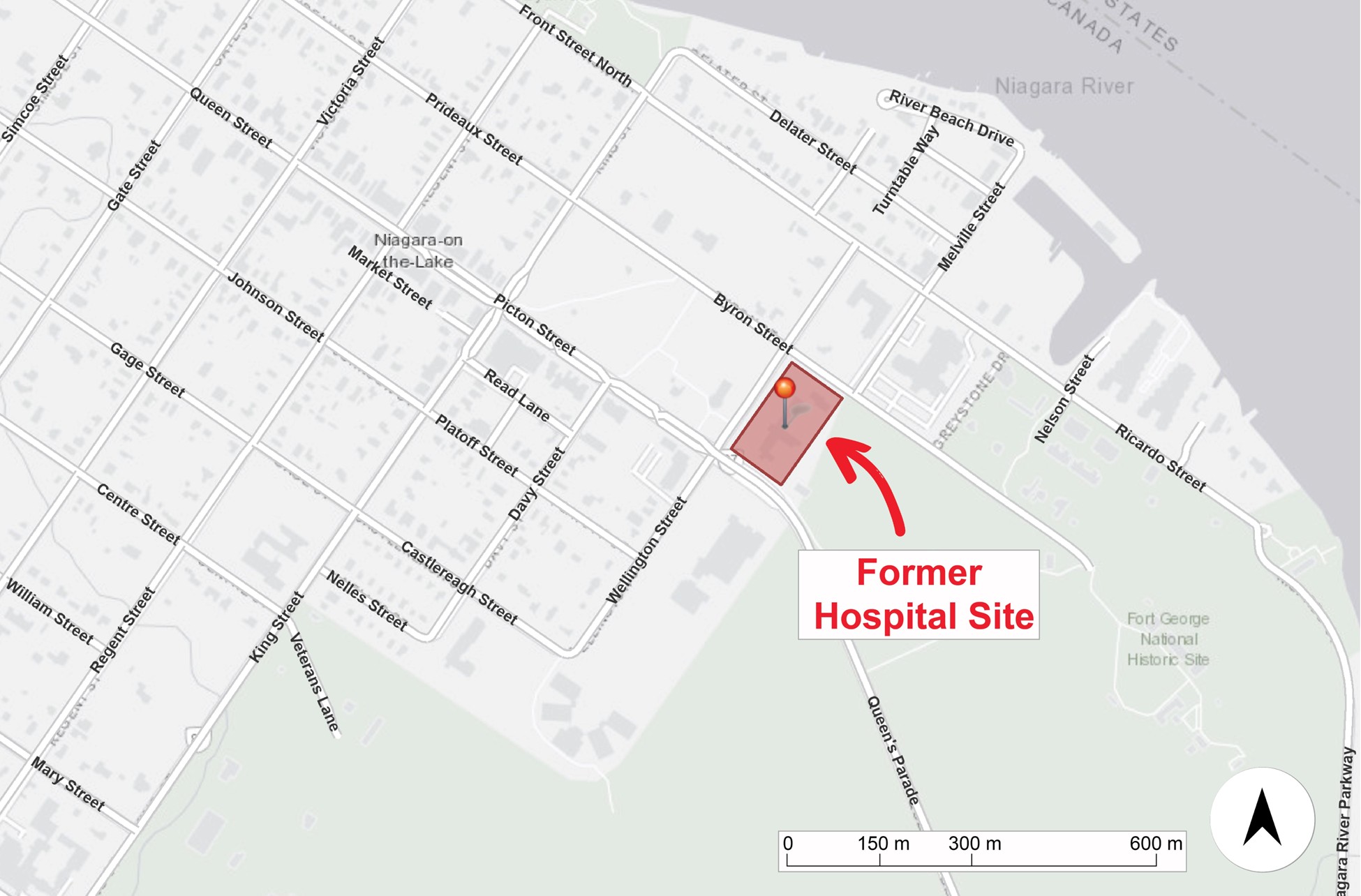
The Former Hospital Site is a 2.32-acre property located within the Old Town urban area, fronting onto Queen’s Parade. The site is bounded by Queen’s Parade to the south, Wellington Street to the west, and Byron Street to the north. To the east are federally owned lands, including Fort George National Historic Site, while to the west, Queen’s Parade transitions into Picton Street and the historic downtown core.
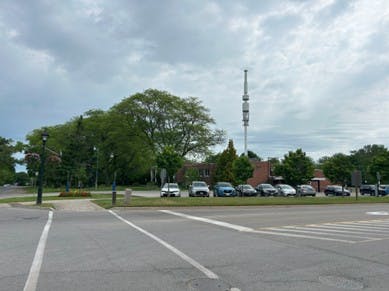
The property includes a two-storey former hospital building, a communication tower, and associated parking areas. The Town currently owns the site and leases portions of it to a local community school, and a small business. Historically, the site has served a range of community health-related functions, including a hospital, nurses’ residence, hospice, and medical offices. Today, it is surrounded by a mix of commercial, residential, institutional, and historic areas, contributing to its strong potential for meaningful community use.
The Town acquired the property from Niagara Health Services after it was declared surplus. Under the Town’s 2017 Official Plan, the lands are designated for open space or community buildings, with current zoning permitting public and institutional uses. Council may consider changes to permitted uses through a future planning process informed by community feedback.
-
The Town of Niagara-on-the-Lake wants to hear from you!
The Town, in partnership with its consultant NPG Planning Solutions, is undertaking community engagement activities throughout the summer and fall of 2025 to gain input on potential future use(s) for the Former Hospital Site, located in Old Town. Help shape the future of this Site by sharing your input through this survey, and continue to get involved in the various opportunities that interest you and fit your schedule!
The Former Hospital Site is located at 176 Wellington Street. It comprises a 2.32-acre lot fronting onto Queen’s Parade, Wellington Street and Byron Street in the Old Town Urban Area. The Site contains the two-storey former hospital building, a communication tower, and parking areas.
This survey closed on August 1, 2025.
 Share Survey on Facebook Share Survey on X (formerly Twitter) Share Survey on Linkedin Email Survey link



-
 Former Hospital Site (176 Wellington Street) – Public Engagement (143 KB) (pdf)
-
Former Hospital Site (176 Wellington Street) - CAO-24-042 (156 KB) (pdf)
-
Licence of Occupancy Agreement with Parks Canada - OPS-25-013 (130 KB) (pdf)
-
176 Wellington Street (Former Hospital Site) - Recommended Use - CAO-26-002 (193 KB) (pdf)
-
176 Wellington Street (Royal Oak School) - CPS-26-004 (116 KB) (pdf)
-
176 Wellington Street (Former Hospital Site) – Background and Feasibility Review - CPS-26-002 (185 KB) (pdf)
-
176 Wellington Street - Former Hospital Site Steering Committee Report - CS-20-002 (173 KB) (pdf)
